Preparing Enterprise Applications for AI: Why Adding a Chatbot Is No Longer Enough
A year ago, almost every conversation about Artificial Intelligence started with the same question: "How can we integrate ChatGPT into our application?"
Today, that conversation has changed.
Companies are no longer looking to simply add a chatbot. These organizations want to automate business processes, help employees make better decisions, and enable AI agents to perform real work within their existing systems.
This presents a completely different challenge, one that has far more to do with how our applications are built, rather than just choosing the "best" AI model.
The real question is much more simple: Is your enterprise application truly ready to work with AI?
Enterprise Applications Have a New Type of User
For decades, we've designed enterprise applications with people in mind.
Users open screens, fill out forms, click buttons, review reports, approve requests, and complete business workflows.
Every process is built around the same assumption: there will always be a person interacting with the application.
But that's changing. AI assistants, copilots, and autonomous agents don't use software the way humans do. They don't navigate menus, search through dozens of screens, or click the Save button.
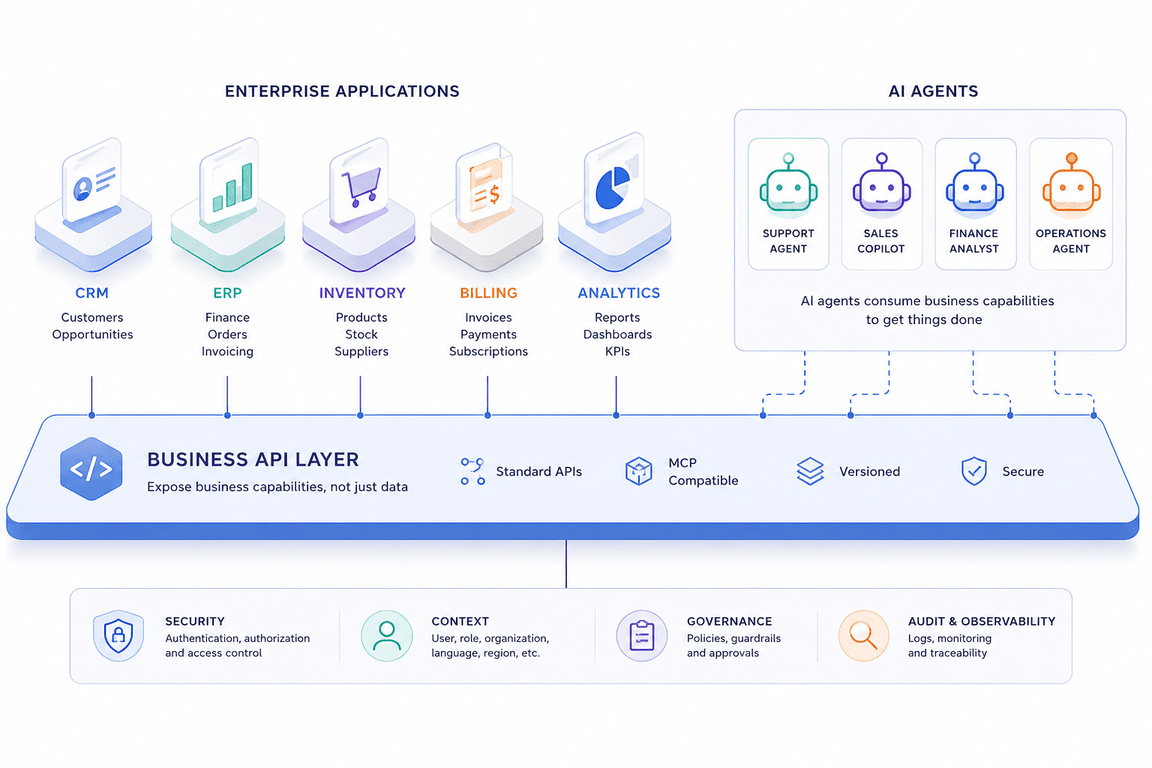
Instead, they expect something very different: direct access to the application's business capabilities so they can retrieve information or execute actions automatically.
In many ways, Artificial Intelligence has become a new type of user and the question is whether our software is ready to work with it.
The Biggest Mistake When Introducing AI into an Application
One of the most common mistakes we're seeing is users treating AI as just another feature: a chat window is added, it's connected to a language model, and the project is considered complete… but that's only scratching the surface.
Imagine asking your ERP system:
"Show me customers with overdue invoices."
A chatbot can probably answer that question.
Now imagine asking:
"Identify customers with overdue invoices, generate a personalized reminder for each one, send the reminders for approval, and notify the sales manager."
At that point, generating text is no longer enough. The application needs to provide business logic, permissions, context, workflows, auditing, and secure access to business operations.
In other words, it needs to be designed to collaborate with AI—not simply display AI-generated responses.
Being AI-Ready Is Primarily an Architectural Challenge
An AI-ready application isn't one that includes more Artificial Intelligence. It's one whose architecture enables AI systems to interact with it safely, efficiently, and reliably. Applications prepared for this new reality tend to share several key characteristics. They Expose Business Capabilities, Not Just CRUD APIs.
Many traditional APIs describe technical operations such as:
- Create Customer
- Update Order
- Delete Invoice
AI agents, however, understand business actions much better, for example:
- Approve an invoice
- Generate a sales proposal
- Search active contracts
- Renew a subscription
- Schedule maintenance
When APIs represent business capabilities instead of simple database operations, they become more useful not only for AI but also for other applications, integrations, and future automation initiatives.
They Provide Context
Context is what turns a generic response into a valuable one.
An intelligent assistant shouldn't only know the user's question. It also needs to understand:
- Who the user is.
- What permissions they have.
- Which customer they're working with.
- Which project they're currently viewing.
- Which language they're using.
- Which country or region they operate in.
Without that context, even the most advanced AI model is forced to make assumptions, and enterprise applications should never rely on assumptions.
Governance Is No Longer Optional
As AI evolves from answering questions to executing actions within enterprise applications, governance becomes a critical requirement.
Every organization should be able to answer questions, such as:
- Who initiated this operation?
- What information did the AI access?
- Which model was used?
- What decision was made?
- Can we audit this action six months from now?
The reality is that these requirements have always existed in enterprise software.
The difference is that AI has made them impossible to ignore.
Open Standards Will Matter More Than AI Models
The AI landscape is evolving at an extraordinary pace: new models appear, pricing changes. capabilities improve.
Today's market leader may no longer hold that position a year from now, and that's why it's increasingly risky to build applications that depend on a single AI provider.
More and more organizations are embracing open standards such as the Model Context Protocol (MCP), which allows applications to expose tools and business capabilities through a common interface that different AI assistants and agents can consume.
This approach decouples enterprise applications from individual AI models, making them far more flexible as the market continues to evolve.
How to Start Preparing an Existing Application
The good news is that preparing an application for AI doesn't require rewriting it from scratch. In most cases, it simply means starting a gradual architectural evolution.
A good place to begin is by asking questions like:
- Do our APIs represent business processes or merely database operations?
- Could an external AI agent easily understand our business objects?
- Are we providing enough context to AI systems?
- Are our permission models consistent and reusable?
- Can every action performed by an AI assistant be audited?
- Are we adopting open standards that prevent vendor lock-in?
If several of these answers are "not yet," you've probably identified the real starting point of your AI strategy.
Final Thoughts
The organizations that will gain the greatest competitive advantage from Artificial Intelligence won’t necessarily be those using the most advanced language model.
They’ll be the ones whose applications are ready to collaborate with whatever intelligent systems emerge in the years ahead.
Because ultimately, preparing an enterprise application for AI isn’t about adding more intelligence.
It’s about building software that’s ready to work with it.
Planning to bring AI into your enterprise application? We would be happy to help. Get in touch and let’s discuss your project.
Need help with this in your own CakePHP app?
Talk to a CakePHP expert