One of the most common questions we hear from teams maintaining older CakePHP applications is:
Should we upgrade this application, or should we rewrite it?
It is an important question because the wrong decision can be expensive.
A rewrite may sound attractive because it promises a clean start, but rewrites often take longer than expected, introduce new bugs, and delay business improvements. On the other hand, an upgrade can be a safer and faster path when the existing application is still well structured and the framework version is not too far behind.
In our experience, the right answer depends heavily on the CakePHP version, the condition of the application, and the business goals behind the modernization effort.
The Problem
Many CakePHP applications have been running successfully for years. They support internal workflows, customer portals, reporting systems, admin panels, payment flows, or business-critical operations.
From the outside, the application may look stable. Users can log in, forms work, reports are generated, and the business continues to rely on it every day.
The problem usually appears when something changes:
- A security audit is required
- A client asks for compliance evidence
- The PHP version is no longer supported
- A dependency cannot be upgraded
- New features become harder to deliver
- Developers are afraid to touch the codebase
- The application needs better performance, security, or integration options
At that point, the team has to decide whether to upgrade the existing application or rewrite it from scratch.
Why This Decision Matters
The upgrade vs rewrite decision is not only a technical decision, it is a business decision.
A rewrite can be the right choice in some cases, especially when the application is very old, difficult to maintain, or no longer reflects how the business works.
However, a rewrite also carries risk.
You are not only rebuilding code, you are rebuilding years of business logic, edge cases, user expectations, permissions, workflows, and integrations.
Many legacy applications contain knowledge that is not fully documented. Some rules exist only because they were added years ago to support a specific client, internal process, or operational requirement.
If those details are missed during a rewrite, the new application may look better, but fail to support the business correctly.
An upgrade, when possible, can reduce that risk. It allows the team to modernize the application while preserving existing behavior and improving the codebase step by step.
Our Practical Rule of Thumb
Based on our experience with CakePHP applications, a useful starting point is this:
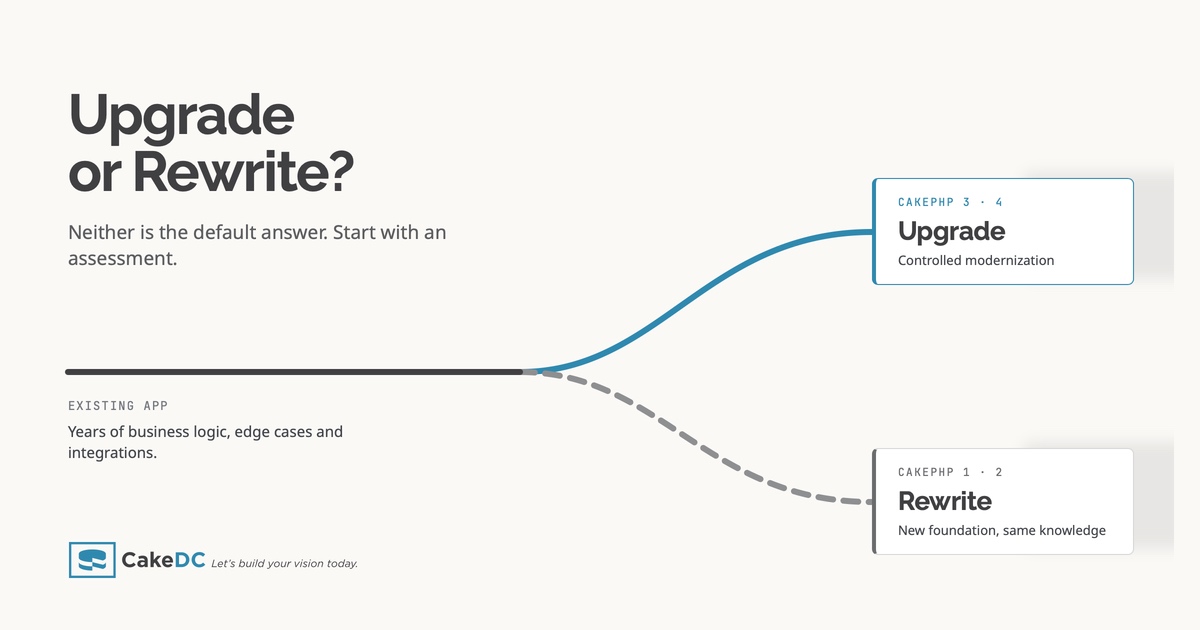
CakePHP 1 and CakePHP 2 applications often need a rewrite conversation. CakePHP 3 and CakePHP 4 applications are usually better candidates for an upgrade.
This is not an absolute rule, but it is a practical way to start the assessment.
CakePHP 1 and CakePHP 2: When Rewrite Often Makes Sense
For applications still running on CakePHP 1 or CakePHP 2, the gap between the current codebase and a modern CakePHP application is usually significant.
The framework architecture, application structure, conventions, dependencies, PHP compatibility, and development practices have changed a lot since those versions.
In these cases, a direct upgrade may still be technically possible, but it can become very close to a rewrite in terms of effort.
Common challenges include:
- Very old PHP versions
- Outdated plugins or dependencies
- Custom framework modifications
- Old authentication patterns
- Deprecated coding practices
- Limited or missing automated tests
- Business logic mixed into controllers or views
- Old frontend patterns tightly coupled to backend code
- Lack of documentation around important workflows
When an application has many of these issues, the team should seriously evaluate whether a rewrite is the cleaner and safer path.
That does not mean throwing everything away without analysis. The existing application is still valuable because it documents how the business works. But instead of trying to mechanically upgrade everything, it may be better to use the old system as a reference and rebuild the application with a modern architecture.
In this scenario, the old application becomes the functional blueprint.
The goal is not to copy every line of code. The goal is to preserve the business knowledge while creating a cleaner, more maintainable foundation.
CakePHP 3 and CakePHP 4: When Upgrade Is Usually the Better Path
For applications running on CakePHP 3 or CakePHP 4, the situation is usually different.
These applications are already closer to the modern CakePHP structure. They are more likely to use Composer, namespaces, newer ORM patterns, improved configuration, and a structure that can move forward more gradually.
In many cases, a rewrite is not necessary.
A planned upgrade can usually deliver the business benefits with less risk:
- Newer CakePHP version
- Supported PHP version
- Better security posture
- Cleaner dependencies
- Better long-term maintainability
- Improved performance opportunities
- More confidence for future development
- A path toward modern frontend or API improvements
For these applications, the best approach is often incremental modernization.
That is where an upgrade strategy can be very effective.
Technical Explanation
The main reason this decision changes by version is the size of the gap.
With CakePHP 1 or CakePHP 2, the application may be several architectural generations behind. The upgrade path may involve changes across almost every layer of the system:
- Application structure
- Configuration
- Routing
- Controllers
- Models and ORM usage
- Authentication
- Plugins
- Templates
- Tests
- PHP compatibility
- Deployment process
At some point, the work stops looking like an upgrade and starts looking like a rebuild.
With CakePHP 3 or CakePHP 4, the application is usually closer to the current ecosystem. There are still breaking changes to handle, but the path is more manageable. The team can usually work through deprecations, update dependencies, adjust code patterns, and move version by version.
That is a very different type of project.
One path is closer to rebuilding the application foundation.
The other path is closer to controlled modernization.
Practical Guidance: How to Decide
Before choosing to upgrade or rewrite, we recommend reviewing the application across a few key areas.
1. Current CakePHP Version
Start with the version.
If the application is on CakePHP 1 or CakePHP 2, do not assume a direct upgrade is the best option. Review whether the effort would be similar to a rewrite.
If the application is on CakePHP 3 or CakePHP 4, an upgrade should usually be considered first.
2. Codebase Quality
Look at how the application is structured.
Ask:
- Is the business logic organized clearly?
- Are controllers too large?
- Are models and services understandable?
- Are views tightly coupled to business logic?
- Are there many custom patches or workarounds?
- Can developers safely make changes?
A clean CakePHP 3 application may be a very good upgrade candidate. A heavily customized CakePHP 2 application, however, may be better suited for a rebuild.
3. Test Coverage
Tests are a major factor.
If the application has automated tests, an upgrade becomes safer. The team can verify that key behavior still works after each step.
If there are no tests, the first phase should usually include creating a basic safety net around critical workflows.
This does not mean testing everything. It means protecting the parts of the system the business depends on most.
4. Business Logic Complexity
Some applications look simple but contain years of hidden business logic.
Before rewriting, identify:
- Critical workflows
- Permission rules
- Reports
- Integrations
- Edge cases
- Admin processes
- Background jobs
- Data import/export flows
If the business logic is complex and still valid, an upgrade may be safer than a rewrite because it reduces the risk of missing important behavior.
5. Dependencies and Plugins
Old dependencies can make upgrades harder.
Review:
- Third-party plugins
- Custom plugins
- Payment integrations
- Authentication integrations
- APIs
- Background workers
- Frontend dependencies
- Server and deployment requirements
If many dependencies are no longer maintained, the project may require replacement work regardless of whether you upgrade or rewrite.
6. Business Goals
The final decision should connect to the business goal.
If the goal is to reduce security risk, update PHP, and keep the existing system running... then an upgrade may be the right path.
If the goal is to completely redesign the product, change the user experience, replace old workflows, or build a new platform...a rewrite may make more sense.
The question is not only “What version are we on?”
The real question is:
What outcome does the business need, and which path gets us there with the least risk?
CakeDC Perspective
From our experience, the mistake many teams make is treating upgrade vs rewrite as a purely technical preference.
Developers may prefer a rewrite because it feels cleaner. Business stakeholders may prefer an upgrade because it sounds faster. But neither answer is automatically correct.
The best decision comes from assessing the current application honestly.
For CakePHP 1 and CakePHP 2 applications, we often see that the amount of required change is so large that a rewrite or rebuild becomes a serious option. The application can still be used as a reference, but the new version may need a modern foundation.
For CakePHP 3 and CakePHP 4 applications, we usually recommend exploring the upgrade path first. These applications are often close enough to modern CakePHP that a controlled upgrade can provide the benefits without the cost and risk of starting again from zero.
A rewrite should not be the default answer.
An upgrade should not be automatic either.
The right approach is to review the application, understand the risks, and choose the path that protects the business while moving the technology forward.
A Simple Decision Framework
Use this as a starting point:
| Application Situation | Recommended Direction |
|---|---|
| CakePHP 1 application | Usually evaluate rewrite |
| CakePHP 2 application with heavy customization | Usually evaluate rewrite |
| CakePHP 2 application with clean structure and clear workflows | Assess both upgrade and rewrite options |
| CakePHP 3 application | Usually assess upgrade first |
| CakePHP 4 application | Usually upgrade instead of rewrite |
| Application has strong tests | Upgrade becomes safer |
| Application has no tests | Add critical workflow tests before major changes |
| Business wants the same system, but safer and supported | Upgrade is usually a better fit |
| Business wants a new product or major workflow redesign | Rewrite may be a better fit |
Conclusion
The upgrade vs rewrite decision should be made carefully.
For older CakePHP 1 and CakePHP 2 applications, the best path may often be a rewrite, especially when the codebase is heavily customized, poorly tested, or far from modern PHP and CakePHP practices.
For CakePHP 3 and CakePHP 4 applications, a rewrite is usually not necessary. In many cases, a planned upgrade can modernize the application, reduce risk, improve maintainability, and preserve the business logic that already works.
The best first step is an assessment.
Before deciding to rewrite or upgrade, review the version, code quality, dependencies, tests, business workflows, and long-term goals.
Modernization is not about changing technology for the sake of change, it is about choosing the safest and most valuable path forward.
Not sure whether your CakePHP application should be upgraded or rewritten? CakeDC can help you assess the current codebase, identify the risks, and choose the safest path forward. Get in touch and let’s discuss your project.
Need help with this in your own CakePHP app?
Talk to a CakePHP expert